Garnet Recycling Is a Big Choice. Here's Something to Think About.
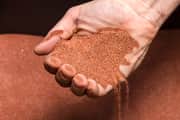
If you run an abrasive waterjet, garnet is not a small line item. It shows up on every invoice, in every catcher tank, and eventually in every disposal bill. So the question keeps coming back around: should we recycle it in house?
The honest answer is that it depends, and probably less on your machine than on your operation.
Recovery Is Not the Same as Reuse
Pulling garnet out of the tank is easy. Turning that garnet back into a reliable cutting medium is not. During cutting, garnet particles fracture, lose mass, and shift into smaller size ranges. Research on abrasive behavior has measured mean garnet particle size dropping by more than half after a single pass through the cutting head. Higher operating pressure tends to make it worse, not better.
What comes out of the tank is a mixed stream of usable particles, fines, moisture, and whatever came off the workpiece. Some of that stream can go back to work. A lot of it should not. Recovered weight is not the same as recovered cutting value.
Why In-House Recycling Rarely Sticks
The Fabricator laid this out clearly in its article “The reality of waterjet abrasive recycling”, pointing to capital cost, operating expense, operator time, drying difficulty, screening difficulty, and yield as the main reasons adoption stayed narrow. Nothing about that list has fundamentally changed.
Most shops still handle it the same way. Spent garnet often goes straight from the tank to a landfill when the cut material does not create a hazardous concern. Interest in recycling picks up when operations start looking past labor cost and factor in collection, transport, and disposal as part of the real per hour cost of running a waterjet.
Recycling in house is a manufacturing process bolted onto another manufacturing process. Spent abrasive has to be dried, screened, classified, tested, blended, and stored in a way that keeps flow consistent. Miss any of those steps and the recovered stream cuts inconsistently, which erases the savings you were chasing in the first place.
External Recycling Is the Best Option Right Now
For most waterjet operations today, the best option is external recycling. Providers like GMA already run collection points, environmental testing, sieve analysis, and dedicated reprocessing plants at a scale no individual shop can match. BARTON does not currently offer a recycling program, but their own published guidance reinforces the same point. Effective recycling requires separation, classification, dry handling, contaminant removal, dust collection, and virgin make-up abrasive. Those requirements belong in facilities built for them.
That recommendation may change. If future recycling equipment cuts the labor, footprint, and oversight required, in-house recycling could open up for a wider range of shops. For now, external is the more reliable path.
What OMAX Recommends
If you are running an OMAX waterjet and thinking about recycling, start by measuring your actual abrasive consumption and disposal cost before adding equipment. Talk to your garnet provider about their return or recovery program. If your volume does not justify the capital and labor of an in-house system, a managed program will almost always give you better results at lower risk. OMAX customers already benefit from tight nozzle control and efficient cutting parameters, which reduces waste at the source. Pairing that with an external recycling partner is the cleanest way to lower abrasive cost without adding a second process onto your shop floor.
Recycling can work. It just must be managed by people and facilities built for it.
FAQs
Q: Can I recycle garnet from any waterjet, including my OMAX?
Yes. Spent garnet from any abrasive waterjet, including OMAX systems, can be collected and sent to an external recycling program. What matters is whether the recovered material is processed correctly before it goes back to work.
Q: How much garnet can actually be reused?
Published research puts the reusable fraction somewhere between 50 and 61 percent under controlled conditions. That number depends heavily on how the material is dried, screened, and classified after recovery, and on how much fine material is separated out along the way.
Need more garnet? Order garnet now from OMAX Marketplace.
Q: Is in-house recycling ever a good idea?
It can be, for large operations with the volume, space, labor, and quality control to run it as a real process. For most shops, the numbers work better with an external provider handling the recovery side.