Ultimate Guide to Cutting Aluminum with Abrasive Waterjet
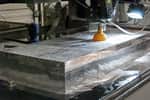
Aluminum is one of the most widely used metals in modern manufacturing, appearing across aerospace, marine, transportation, energy, and general fabrication applications. Despite its popularity, aluminum is also one of the easiest materials to misapply cutting technology. Its softness, thermal sensitivity, and broad range of alloys mean that selecting the wrong cutting process can lead to warped parts, inconsistent edges, excess secondary work, and higher total cost.
At OMAX, this challenge shows up daily across job shops, production floors, and high‑mix manufacturing environments. Abrasive waterjet cutting is often the best solution for aluminum when material integrity, edge quality, and thickness flexibility matter. The right cutting process depends on the application and on how the part will be used after it is cut.
This guide explains how aluminum behaves during cutting, where OMAX abrasive waterjet systems perform best, where thermal processes such as plasma cutting are the better fit, and how manufacturers can evaluate tradeoffs using application‑driven criteria rather than assumptions. OMAX also provides additional background comparing waterjet to other cutting technologies for shops evaluating multiple processes.
Why Aluminum Requires a Thoughtful Cutting Approach
Aluminum behaves very differently from steel. It conducts heat rapidly, melts at a lower temperature, and is far more prone to distortion when exposed to localized thermal energy. These characteristics do not make aluminum difficult to cut, but they do make process selection critical.
Thermal cutting methods, including plasma and laser, introduce concentrated heat into the material. In some aluminum applications, that heat is acceptable and even beneficial. In others, it results in warped parts, loss of flatness, heat‑affected zones that alter alloy properties, oxidized or hardened cut edges, and additional secondary operations such as grinding or straightening.
OMAX abrasive waterjet cutting avoids these issues entirely. By cutting aluminum mechanically using a high‑pressure stream of water mixed with abrasive, waterjet introduces no heat into the material. There is no heat‑affected zone, no recast layer, and no change to the aluminum’s temper or mechanical properties. For many aluminum applications, especially those with tight tolerances or downstream processing requirements, this distinction directly affects part performance and repeatability.
Understanding Aluminum Alloys and Manufacturing Variability
One reason aluminum can be challenging to process consistently is the wide variation between alloys. Softer alloys such as 5052 and 1100 behave very differently from high‑strength, heat‑treated alloys like 6061‑T6 or 7075.
With thermal cutting processes, changes in alloy composition often require adjustments to parameters, consumables, or cutting strategy. Abrasive waterjet cutting behaves consistently across nearly all aluminum grades. While cutting speed may vary depending on hardness and thickness, the underlying process remains stable and predictable.
For shops that regularly process multiple aluminum alloys in a single workflow, this consistency reduces setup time, minimizes scrap risk, and helps maintain repeatable part quality without constant parameter changes.
What Makes Abrasive Waterjet Ideal for Aluminum
Cold Cutting and Preservation of Material Properties
Abrasive waterjet cutting is a true cold cutting process. Heat‑treated aluminum alloys retain their mechanical properties because no thermal energy is introduced during cutting. This is especially important in aerospace, marine, and structural applications where predictable strength, fatigue resistance, and weld behavior matter.
Cold cutting also minimizes residual stress. Thin aluminum sheets remain flat, and thick aluminum plates maintain dimensional stability throughout the cut, even on longer or more complex toolpaths.
Edge Quality Without Secondary Processing
Waterjet‑cut aluminum edges are smooth, square, and burrfree. In many applications, parts come off the table ready for assembly, anodizing, or welding without the need for grinding, sanding, or manual deburring.
Although abrasive waterjet cutting eliminating secondary edge‑finishing operations often reduces total job time and labor cost. For many shops, this is where waterjet delivers its biggest economic advantage.
Thickness Capability Without Process Changes
OMAX abrasive waterjet systems routinely cut aluminum from thin sheet to very thick plate, often exceeding 12 inches in thickness. Material thickness affects cutting speed but does not change feasibility or quality.
Unlike thermal processes, waterjet cutting does not require changing gases, or cutting strategies as thickness increases. This allows a single machine to support a wide range of aluminum work without reconfiguration, making waterjet particularly well suited to high‑mix and job shop environments.
Complex Geometry and Precision Features
Waterjet cutting excels at producing complex geometries, tight inside radii, and intricate internal features. Because no heat is introduced, dimensional accuracy is maintained even in thin webs and narrow profiles that would otherwise be prone to distortion.
Five‑axis waterjet systems can also cut bevels, chamfers, countersinks, and weld‑prep features directly, reducing or eliminating secondary machining operations.
Mixed Materials and Stacked Cutting
One of the most significant advantages of abrasive waterjet cutting is its ability to process mixed materials in a single operation. Aluminum can be cut alongside stainless steel, plastics, rubber, composites, laminates, and other materials without requiring tooling change or compromising cut quality.
This capability is especially valuable in aerospace, marine, and energy applications where aluminum is often part of a multi‑material assembly. Thermal cutting processes generally cannot accommodate these combinations without splitting operations and increasing handling time.
Common Aluminum Applications for Abrasive Waterjet
OMAX abrasive waterjet systems are commonly used for aerospace brackets, marine structures, thick aluminum tooling plates, composite‑aluminum hybrid assemblies, and weld preparation where distortion must be avoided.
In these applications, eliminating heat input often outweighs the advantages of faster thermal cutting methods.
Frequently Asked Questions
Q: Does waterjet cutting affect aluminum temper or strength?
A: No. Abrasive waterjet cutting introduces no heat, so the mechanical and metallurgical properties of aluminum alloys remain unchanged.
Q: Can a waterjet cut beveled or angled aluminum edges?
A: Yes. Five‑axis waterjet systems can cut bevels, chamfers, and weld‑prep features directly into aluminum parts.
Q: Is abrasive waterjet suitable for production environments?
A: Abrasive waterjet excels in low‑to‑medium volume production, high‑mix operations, and applications where accuracy, flexibility, and material integrity matter more than raw cutting speed.