Waterjet vs Laser vs EDM: Choosing the Right Cutting Process
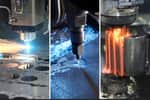
Picture a job that lands on your bench: a one-inch titanium bracket, tight tolerance requirements, and a delivery date that leaves little room for rework. Do you cut it on an OMAX abrasive waterjet cutter, a laser, or wire EDM? The right answer depends on material, thickness, tolerance, heat sensitivity, edge quality, and production volume. This article compares abrasive waterjet, laser, and wire EDM on the specifications that decide the job, including accuracy, heat-affected zone, thickness range, kerf, edge quality, cutting speed, and cost per part. The waterjet vs laser cutting and waterjet vs EDM machining questions rarely have one universal answer. The goal is to match each process to the part in front of you.
Choosing Between Waterjet, Laser, and EDM
Every cutting process trades one strength for another. Wire EDM holds the tightest tolerances, but only on conductive metals and usually at slower speeds. Laser moves fast on thin, flat, non-reflective sheet, but it brings heat into the cut. Abrasive waterjet covers the widest range of materials and thicknesses without adding heat to the part.
The best process depends on the part, but the variables that make cutting jobs difficult, including mixed materials, thicker stock, reflective alloys, and heat-sensitive edges, are the same variables that often favor an OMAX abrasive waterjet. A shop running thin aluminum sheet at high volume may still choose laser. A shop finishing ultra-tight conductive features may still choose EDM. For changing job-shop work, waterjet usually gives you the broadest first move.
|
If your priority is... |
Start with... |
Why |
|
No heat-affected zone, mixed materials, or thick stock |
Abrasive waterjet |
Cold cutting avoids thermal distortion and works across metals, composites, glass, stone, plastics, and other materials. |
|
Fast production when the job is thin, flat, and non-reflective sheet metal |
Laser cutting |
Laser is typically fastest when material is thin, stable under heat, and suited to the beam and assist gas setup. |
|
Ultra-tight features in conductive metals when speed is secondary |
Wire EDM for finishing critical features |
EDM excels at extreme precision, but its speed and conductivity limits make it better for critical features than broad cutting work. |
How Each Cutting Process Removes Material
Understanding the physics of each process explains most of the tradeoffs. One erodes with abrasive-laden water, one uses focused heat, and one uses electrical sparks.
Abrasive Waterjet Cutting
An OMAX abrasive waterjet uses a high-pressure stream of water to erode a narrow line in the material. The machine consists of three basic components:
- The table: X-Y table with a nozzle, a garnet hopper, and a catcher tank below.
- The pump: a high-pressure pump that provides pressurized water for the cutting process.
- The controller: software that manages system operation, motion control, and nozzle positioning.
Because the abrasive is introduced directly into the cutting stream, an OMAX abrasive waterjet can handle a wide range of materials and thicknesses on the same platform. That flexibility lets one system move from thin stock to thick titanium brackets without swapping processes.
Laser Cutting
Laser cutting is a thermal process. A focused beam melts, burns, or vaporizes the material along the cut line. The laser source can be gas-based, such as CO2, or solid-state, and either the beam or the material moves during the cut.
Thickness is where laser shows its limit. The general laser ceiling is around 0.25 inch, although some higher-power systems can reach 30 to 40 mm. Treat these as two data points: laser stays efficient on thinner stock, with capacity varying by machine power.
That makes laser the right answer for some production work, but not all production work. Once the job moves into thicker stock, reflective metals, or parts that cannot tolerate heat at the edge, the case for abrasive waterjet gets stronger.
Wire EDM
Wire EDM is a spark-erosion process. An electrical arc rapidly discharges between the wire electrode and the workpiece, and the series of arcs melts and vaporizes the material, with debris flushed away by dielectric fluid.
That mechanism carries one hard constraint: EDM works only on electrically conductive materials. Within that limit, EDM excels at intricate features in hardened metals that are difficult to machine by conventional methods. It is a precision tool first, which is why it often makes more sense after the broader profile has already been cut.
Waterjet vs Laser vs EDM: Process Comparison at a Glance
The table below compares the specifications buyers ask about most. Read it less as a scoreboard and more as a set of limits: laser narrows around thickness, reflectivity, and heat; EDM narrows around conductivity and speed; abrasive waterjet keeps the widest lane open.
|
Process Characteristic |
Abrasive Waterjet |
Laser Cutting |
Wire EDM |
|
Accuracy / tolerance |
Average ±0.003 in (±0.08 mm), up to ±0.001 in (±25 μm) |
Tight on suitable thin sheet; accuracy depends on material, thickness, and heat control |
Extremely tight, but limited to conductive materials and slower cutting speeds |
|
Material thickness range |
Up to 24 in (61 cm) |
Generally under 0.25 in; up to 30–40 mm on some high-power systems |
Up to 12 in (30 cm) |
|
Heat-affected zone (HAZ) |
None; parts stay chemically unaffected with no thermal distortion |
Yes; thermal cutting can harden or alter the edge |
Localized heat from spark erosion; best for precision features, not broad heat-free cutting |
|
Kerf width and edge quality |
Good edge; minimum kerf near 0.02 in (0.5 mm) |
Finer kerf about 0.006 in (0.15 mm) |
Excellent edge on conductive materials, usually at slower speeds |
|
Material compatibility / limitations |
Virtually all materials |
Non-reflective metals only |
Conductive materials only |
|
Relative cutting speed |
5–10x faster than wire EDM under 1 in thick; typical cutting speeds vary by material and thickness |
Very fast on thin non-reflective stock; speed varies by material, thickness, and system power |
5–10x slower than waterjet under 1 in |
Actual results vary by material, thickness, geometry, system configuration, and production requirements, but the pattern is consistent: abrasive waterjet offers the broadest cutting range without adding heat to the part.
Why Abrasive Waterjet Is Usually the First Process to Consider
An OMAX abrasive waterjet is often the right starting point because it solves the problems that narrow the other two processes. Laser is strongest when the work is thin, flat, and non-reflective. EDM is strongest when the material is conductive and the feature requires extreme precision. Waterjet covers the broader middle: mixed materials, thicker stock, reflective alloys, heat-sensitive parts, and jobs that change from one run to the next.
OMAX abrasive waterjet systems pair high-pressure pump technology, precision motion control, and IntelliMAX Software to support accurate cutting across a wide range of materials and thicknesses.
The OMAX lineup scales and configures to the work. Cutting envelopes range from compact machines to large-format systems, with high-accuracy options such as the OptiMAX 60X and MicroMAX available for tighter work. Because abrasive waterjet cutting is not limited by reflectivity, conductivity, or heat sensitivity, one machine can support a broad mix of production and job-shop work.
To size the right machine for your material and thickness range, compare OMAX waterjets or browse the full OMAX product lineup.
Common Misconceptions About Waterjet, Laser, and EDM Cutting
Myth: waterjet can't hold tight tolerances. OMAX systems offer linear positioning accuracy as tight as ±0.001 in on the OptiMAX 60X and ±0.0001 in on the MicroMAX, alongside a general ±0.003 in to ±0.001 in range for abrasive waterjet cutting.
Myth: waterjet is inherently loud and messy. When cutting under water, OMAX waterjets can be significantly quieter than more machine tools. In typical operation, noise is around 76 dBA, about the same as a dishwasher on a heavy setting, helping reduce the noise and mess often associated with traditional waterjet cutting.
Myth: laser is always cheaper or faster. Laser can be fast on thin, flat, non-reflective sheet, but upfront costs can be significant, with high-end industrial fiber laser systems costing more than $1 million before factoring in automation, utilities, assist gas, installation, and application-specific setup. Laser's thickness ceiling also limits it for thick or heat-sensitive parts, where waterjet stays viable without the heat-hardened edge laser leaves.
Myth: EDM is the only path to tight tolerances. EDM leads at the extreme end of precision and can produce fine kerfs and excellent edge quality, but it is limited to conductive materials and usually runs slower than waterjet. For the bulk of a job, especially under 1 inch thick, abrasive waterjet is often the more practical first cut, reserving EDM for the features that need extreme accuracy or ultra-fine detail.
Frequently Asked Questions About Waterjet, Laser, and EDM Cutting
Is CNC waterjet cutting fast enough for production runs?
Yes, especially against EDM. Abrasive waterjets cut 5–10 times faster than wire EDM on material under 1 inch thick.
Does abrasive waterjet cutting work on non-conductive materials like glass and composites?
Yes. Abrasive waterjets cut virtually any material, including glass, composites, and reflective metals. This is a key difference from wire EDM, which is limited to electrically conductive materials.
Why does laser cutting leave a heat-hardened edge that waterjet does not?
Laser is a thermal process that melts and vaporizes material, which alters the edge and can create a heat-affected zone. Waterjet is a cold-cutting process, so it produces no HAZ and does not change material properties. That difference matters when secondary operations like tapping or beveling follow the cut.
How loud is a CNC waterjet cutter compared to a laser?
Waterjet and laser noise levels vary by machine design, cutting conditions, material, and enclosure. OMAX systems with water-level control support quieter submerged cutting, which can reduce the noise often associated with open waterjet operation.
For shops comparing waterjet, laser, and EDM, the decision often starts with the limits of the part. Thin, flat, non-reflective sheet may point to laser. Ultra-tight conductive features may point to EDM. But when the work involves mixed materials, thicker stock, reflective alloys, heat-sensitive parts, or changing job requirements, abrasive waterjet is usually the most flexible place to start.