Maximize Marble Yield with OMAX Waterjet Cutting Techniques
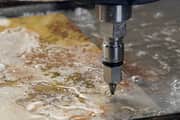
Premium marble is expensive, unforgiving, and difficult to replace when something goes wrong. Every chipped edge, cracked corner, or marred surface shows up immediately in material cost. Unlike commodity materials, marble offers very little margin for error. When a slab fails, the loss is immediate and often unrecoverable.
For fabricators working with marble, maximizing yield is about protecting profitability. That means getting more finished, presentation‑ready parts from every slab while reducing the risk of edge damage, cosmetic defects, and rework. Achieving that balance requires disciplined process control and a cutting technology designed specifically for brittle stone.
OMAX abrasive waterjet systems provide a practical path forward. The controlled erosion process, combined with intelligent software and proven operating techniques, allows shops to cut marble cleanly, accurately, and predictably. The result is better material utilization, higher edge quality, and fewer rejected parts, especially for high‑value applications like flooring patterns, medallions, and architectural inlays.
Why Marble Demands a Controlled, Low‑Impact Cutting Process
Marble looks durable, but from a fabrication standpoint it behaves more like glass than metal. Its grain structure, veining, and mineral composition vary across the slab, creating natural weak points that are prone to chipping, spalling, and surface bruising during cutting.
Traditional cutting methods rely on physical contact and lateral force. As tooling engages the stone, vibration and side loading can pull material away at the cut edge, leaving chips and micro‑damage that require hand finishing or result in rejected parts. These issues are especially costly on visible edges and decorative work, where surface quality matters as much as dimensional accuracy.
Abrasive waterjet cutting removes material through precise erosion rather than force. The jet does not apply sideways pressure to the stone, which significantly reduces edge chipping and surface disturbance along the cut path. The result is a cleaner, more uniform edge that holds up through handling, transport, and installation.
Key benefits include reduced edge chipping and breakout, even on brittle or veined marble, minimal surface disturbance near the cut that preserves finished appearance, and the ability to cut complex geometries without secondary tooling.
Planning for Yield Before Cutting Begins
Maximizing marble yield starts before the first cut is made. How parts are laid out on the slab often has a greater impact on material utilization than cutting speed or pressure.
OMAX IntelliMAX Software gives operators direct control over part placement, nesting density, and toolpath behavior.
Commonline cutting is one of the most effective techniques for improving yield. By allowing adjacent parts to share a cut line, material between parts is eliminated and total cut length is reduced. This works especially well for tiled shapes and repeating patterns, provided the slab remains stable and well supported throughout the cut.
Equally important is having a remnant strategy. Leftover sections from large slabs can often be reused for smaller components or future jobs.
Cutting Techniques That Protect Marble Integrity
Even with excellent nesting, poor cutting technique can destroy yield. Marble requires a controlled approach at every stage of the cut.
Low‑pressure piercing is essential for interior starts. A full‑pressure pierce delivers a sudden impact that can chip or fracture brittle stone. OMAX systems allow operators to pierce gently, reducing damage at the initiation point. This is especially important on visible surfaces, where small defects can telegraph through polishing or finishing.
Lead‑ins and lead‑outs are equally critical. The pierce itself can leave a cosmetic blemish. By moving the pierce into scrap material, the jet stabilizes before entering finished geometry, preserving edge quality and reducing rework. IntelliMAX automatically sets lead-in and lead-outs streamlining CAD work prior to cutting.
Proper material support cannot be overlooked. Marble slabs are rarely perfectly flat, and unsupported sections can vibrate under the force of the jet. That vibration increases the risk of cracking and can bruise the surface near the cut. Full, even support across the cutting bed helps protect both structural integrity and finished appearance.
Avoiding Common Marble Cutting Mistakes
Yield loss in marble cutting is rarely random. Most failures follow predictable patterns.
Piercing at full pressure on interior cuts remains one of the most common causes of chipped edges and slab failure. Inadequate or uneven support leads to vibration‑induced damage. For inlay work, failing to use taper compensation can result in poor fit due to the natural V‑shaped cut profile of the waterjet stream.
Another frequent mistake is assuming all marble behaves the same. Density and mineral composition vary significantly between slabs. Entering accurate material data into the IntelliMAX cutting model allows the system to calculate proper speeds and corner behavior, resulting in more consistent edge quality across the job.
Using OMAX Software to Control the Cut
What differentiates OMAX waterjet systems is the integration between machine and software. IntelliMAX Software uses a cutting model built from decades of material research to automatically calculate nozzle speed, acceleration, and corner behavior.
For decorative inlays and tight‑fitting assemblies, taper compensation can be enabled on compatible systems. By tilting the nozzle during cutting, the system counteracts natural jet divergence and produces straighter, more vertical edges. While taper compensation can slightly increase cutting time, it often eliminates secondary finishing and improves the final visual quality of the part.
Turning Process Control into Profitability
Maximizing marble yield is not about pushing speed or pressure. It is about consistency.
Strategic nesting reduces waste before cutting begins. Low‑pressure piercing protects the stone at the start of each cut. Proper support minimizes vibration and surface damage. Lead‑ins preserve finished edges. Software‑driven cutting models ensure repeatable results across every slab.
When combined, these practices allow shops to produce more finished, installation‑ready parts from every slab and confidently take on higher‑value marble work. With OMAX waterjet systems, marble cutting becomes more predictable, visually consistent, and far more profitable.
FAQs for Waterjet Marble Cutting
Q: How does waterjet cutting reduce chipping in marble?
A: Abrasive waterjet cutting removes material without physical contact or side loading. This significantly reduces edge chipping and breakout compared to contact‑based cutting methods. Features like low‑pressure piercing and controlled lead‑ins further protect the stone at the start of each cut.
Q: Can an OMAX waterjet cut thick marble slabs accurately?
A: Yes. OMAX abrasive waterjets can cut thick marble slabs while maintaining consistent edge quality. IntelliMAX Software automatically adjusts cutting behavior based on material thickness and properties to ensure reliable results through the full cut depth.
Q: What is the best way to cut tight‑fitting marble inlays?
A: Using an abrasive waterjet equipped with taper compensation is the most effective approach. The system produces straighter edges, allowing tighter fits and more seamless visual transitions between mating pieces.