Boost Production with a 5-Axis Waterjet Cutting Machine
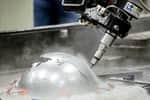
A 5-axis waterjet cutting machine changes how parts move through your shop. Instead of cutting flat profiles and sending parts to secondary machining, you can produce finished geometry in a single setup.
By adding articulation to the cutting head, you reduce or grinding, and manual prep. Parts move from raw stock to assembly faster, with fewer handoffs and less opportunity for variation.
How 5-Axis Abrasive Waterjet Cutting Works on the Shop Floor
A standard waterjet moves in the X, Y, and Z axis. A 5-axis system adds rotation and tilt to the cutting head, allowing the nozzle to approach the part from different angles. This makes it possible to cut bevels, chamfers, countersinks, and complex 3D features in a single setup.
Processing a part on one machine simplifies fixturing. Operators do not have to reposition the workpiece for angled secondary cuts, which reduces setup time and helps maintain consistency.
Abrasive waterjets can cut metals, composites, ceramics, stone, and glass. On thicker materials, the stream naturally produces a slight V-shaped taper. Multi-axis cutting heads correct for this by tilting the nozzle during the cut.
With proper setup, shops can achieve general part tolerances down to about ±0.005 inches, depending on material, thickness, and cutting conditions.
The Mechanics of Multi-Axis Cutting Heads
Different applications require different levels of control. OMAX offers several multi-axis options designed around specific use cases.
OMAX VersaJET
The VersaJET is a software-controlled 5-axis cutting head with a 0 to 60-degree tilt range. It maintains a fixed focal point, supporting consistent accuracy when cutting beveled edges, angled sides, and countersinks. Available on the MAXIEM, OMAX and OptiMAX Lines.
OMAX TiltaJET
The TiltaJET focuses on taper compensation. It tilts the nozzle up to ±9 degrees and continuously adjusts during the cut. This allows the machine to maintain square edges while running at higher cutting speeds. Available on the OMAX and OptiMAX lines.
You can explore OMAX multi-axis cutting accessories to match the right setup to your application.
Key Variables That Influence Multi-Axis Production Outcomes
Software and Toolpath Control
Multi-axis performance depends on the control software. The OMAX IntelliMAX Software Suite runs OMAX JetMachining Centers using a built-in cutting model that calculates taper and adjusts the toolpath automatically.
This removes the need for manual calculations and reduces operator variability.
Key modules include:
-
LAYOUT
Creates toolpaths from CAD geometry and assigns cut quality levels
-
MAKE
Controls nozzle motion and applies compensation to maintain accuracy
-
IntelliCAM
Imports 3D CAD files and generates both 2D and 3D toolpaths
These tools allow operators to focus on setup and process control instead of programming.
Nozzle Maintenance and Consumables
Consistent output depends on managing wear components. The numbers below are reflected of ideal waterjet conditions and operation.
Typical wear intervals include:
-
Mixing tube: around 50 cutting hours
-
Core nozzle body: around 500 cutting hours
-
Waterjet bed slat: Every 1000 cutting hours or as needed.
Routine maintenance takes about 10 minutes and should be scheduled to avoid downtime.
Where a 5-Axis Waterjet Adds Value
5-axis capability delivers the most impact where parts would otherwise require secondary machining.
Common applications include:
-
Weld preparation and beveling
-
Chamfers and countersinks
-
Thick plate cutting with tight edge requirements
-
Complex 3D profiles
-
Tube and pipe cutting with a rotary axis (with the right additional waterjet accessories)
By removing downstream operations, you reduce cycle time, free up other machines, and simplify your workflow.
Waterjet systems support a wide range of materials on a single platform, from aluminum and tool steel to carbon fiber, ceramics, and glass.
Operating Efficiency and Cost Considerations
OMAX systems use direct-drive and intensifier pumps with high efficiency. Lower energy usage per cut and reduced water consumption help control operating costs without changing your process.
Common Misconceptions About 5-Axis Waterjet Systems
Programming is too complex
Control interfaces like IntelliMAX and IntelliCAM automatically generate multi-axis toolpaths from CAD files. Operators do not need to write G-code.
Multi-axis slows down cutting
Taper compensation helps maintain edge quality without slowing feed rates. In many cases, cutting efficiency improves.
Waterjet is limited to flat plate
With multi-axis heads or a rotary axis, waterjet systems can cut tubes, pipe, and complex 3D geometries.
Next Steps for Evaluating 5-Axis Capability
Start by identifying where parts leave your waterjet for secondary work. Grinding, beveling, and manual prep are where 5-axis capability creates immediate impact.
Import a representative 3D part into IntelliMAX to evaluate toolpaths and cutting strategy. This helps you understand how much can be completed in a single setup.
Then review machine configuration, including table size and cutting head options, to match your material thickness and part geometry.
Frequently Asked Questions
Q: What materials can a 5-axis waterjet cut
A: Abrasive waterjets can cut metals, composites, stone, glass, and ceramics. They can cut thick sections without changing material properties.
Q: How is taper controlled
A: The software calculates taper and adjusts the cutting head angle during the cut to maintain a square edge.
Q: How much maintenance is required
A: Routine nozzle maintenance typically takes about 10 minutes and can be scheduled between jobs.
Q: Do operators need advanced programming skills
A: No. The software imports CAD files and automatically generates optimized toolpaths.